INTERVIEW WITH MEMBER CHARLOTTE BIRD

  An occasional series, featuring an interview with one of our members.


My greatest pleasure is being in the zone, when time stops, my focus is narrow and work gets done without much conscious thought.
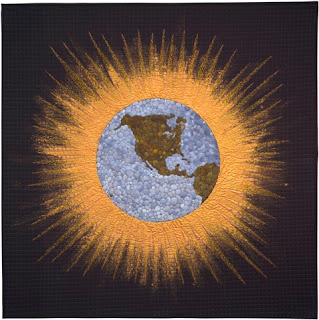

Last Clear Chance, commission for
San Diego Regional Airport Authority

What themes or ideas are reoccurring in your work?
     Time, process and change are reoccurring concepts. My work changes with new techniques, with changes in my personal life, with research when a new idea pops up. Time is part of my process as well. I hand dye most of the fabrics I use. It can take several dye processes to get the color and pattern I want. Machine piecing and machine embroidery are time consuming. I machine quilt all my work and hand embroidery often is a final step. Some pieces go together quickly – less than a week. Others can take months to resolve.  
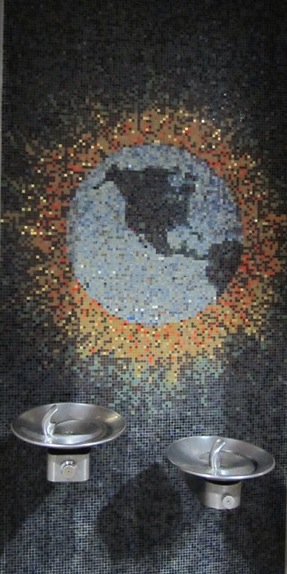
Airport Backsplash,
mosaic tile drinking fountain
San Diego Regional Airport Authority
Terminal 1, near Gate 3, inside security


 How do you approach your work?  Recently I have had commissions that   direct the concepts and content. When I am starting my own work I often begin with fabric…piles of fabric….until something stands out and begins the additive process of image/concept development. After some research, often a simple google search, ideas are refined and manipulated on my wall.   
 What is your creative process?  Sometimes work starts with color and pattern: Sometimes with a concept or word. I often do some research on a concept or word or image. After that my best process is as without thought as possible. Back to that “in the zone.” 
What tool could you not live without?                                                    
Sewing machine, fabric, dictionary or computer since google is now a resource, needle and thread, pencil and eraser.                    
 When did you first become interested in fiber? I’ve been working with fabric since I was a small child. My mother taught me to use the sewing machine when I was very small. We made my school clothes every year through high school. 
 Does California, as a locale, physically or an idea, emotionally, manifest itself in your work?  The clear sunny climate of Southern California appears in my usually preferred color palette-full intensity colors particularly red.  However, I spend a substantial amount of time in interior Alaska at various times of the year. I am drawn to the  subtlety of the color palette there. When I work with an artist friend there I find my palette shifting to grayer and more muted colors.


Chinook, art quilt, 2011. 19"h  x 41"w

        Why did you decide to become a member of California Fibers?           
       I’ve been a CF member since the late 80’s?  (I can’t find a resume with the date of my first  exhibit with CF. It was a show at the Pannikan in Encinitas.). Donna Joslyn who was CF membership chair then encouraged me to jury into the group. CF offered an opportunity to stretch my skills and ideas to art rather than womens clothing which was my focus at the time. I remain a member because that opportunity to stretch and grow continues.
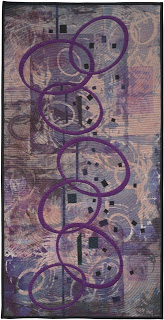


Mistral, art quilt, 2011, 36.5"h x 19"w 


       Which historical figure or artist do you most identify with? I don’t really identify with anyone in particular. Since I have no formal art training, I can pick and choose from among a whole world of artists without having to label a specific organizing genre. However, I am especially fond of the moderns from Helen Frankenthaler and Robert Motherwell to Jasper Johns, Robert Rauschenberg, Lee Krasner and Lee Bontecou. I like simple graphics that have inner meanings that I can figure out or not.

      Which living artist do you most admire? Andy Goldsworthy, his work not his behavior.


What is your motto? 
As Tim Gunn would say, “Make  it work.” 
Levant, art quilt, 2011, 25"h x 18.5"w
I hate to have a piece stall out. I really like my work to resolve. UFOs (unfinished objects) are a thorn in my visual side. I can’t hide them deep enough. Eventually they get cut apart, over dyed, painted on or quietly thrown out so they don’t look at me from the shelf.   


1.    What is the greatest pleasure you get in your work? Being “in the zone” when time stops, my focus is narrow and work gets done without much conscious thought.

 What are your creative challenges? I want to pursue some forms other than quilts: artist books, 3D structures….having enough time to work through new     technical issues is always a challenge.
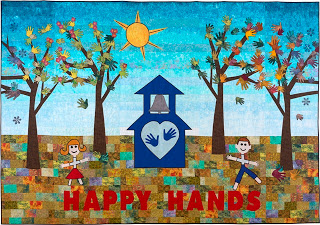
Happy Hands, commission for a private school for
developmentally disabled children, Tulsa, OK
8.5'h x 12.5'w
What is your biggest fear as an artist? 
 I won’t have another good idea.


INTERVIEW WITH MEMBER ELLEN PHILLIPS

An occasional series, featuring an interview with one of our members. 

"Art expands lives, and you don"t have to like it", says Ellen Phillips, a founding member of California Fibers.

Tribal Woman - India(photo by Ellen Phillips)
What are the big ideas that influence your work?

Right now, in photography it is tribal costume, customs, dance, crafts, architecture.  Much of my work comes out of my history, family, World War II.  Themes of Passages: walls/barriers/boundaries/ bridging in sculpture and fiber carried me through the 80s and 90s. 
My public art in the 90s was tied to the place the work was going to be, its community and its history.  A different way of working but one I really enjoyed.  After I finished a large public work for the Dairy Mart Bridge which overlooks the Tijuana River Flood Plane, I felt many of my ideas lost their meaning in the process.  After that public art work I expected my sculpture work to return, but it didn't.  I started taking classes at Grossmont College in the spring of 2004 and have continued there off and on ever since.  I realized that my main art interest was photography - which went along with my other passions: family, the out of doors and traveling.  I was particularly  in backcountry tribal peoples of the world, their costumes, customs, architecture, and crafts.  I mostly optimize selected images, make books of them and frame prints.    
to see Ellen's Dairy Mart Bridge Public Art Work go to http://www.publicaddress.us/artists/phillips.html
Bridging #2, side view


What are some of the pleasures you get in your work? 
Watching it happen.  It's often a struggle to get it right - and some pieces never get there.  But the excitement of getting it right is wonderful.

What is your creative process and some of your creative challenges?
Artists have to work HARD!  Thinking, looking for ideas, developing a series of ideas, choosing one to start with and keep going. Also being open to pieces changing - and perhaps introducing new ideas and series.  Keeping going, staying open to new different ideas, keeping my energy up for all kinds of things - as well as for hiking the mountain.  Keeping the work going when there are so many things to do.  There is never enough time to do everything I want to do - along with the chores of life.
How do you view the artists of today?
I'm interested in ll kinds of art but I'm not looking as much as I used to.  Some of it doesn't look much like art, but I've learned those are the artists to watch most closely - I might learn something.  Art expands our lives - and you don't have to like it.

  
Bridging #2, mixed media

What is your biggest fear?

I have no fear now.  When I started back to school in art in 1974, I was scared stiff.  I went to Grossmont College to take a ceramics class.  I was already a potter so I took the second level class.  I figured I knew something about clay so they probably wouldn’t throw me out.  Les Lawrence had me making art by the end of that semester.  Before that class I made mostly useful objects.  My art piece looked pretty awful – but I knew the difference.  And he said go take all the drawing/painting/sculpture/art history/etc. classes you have never had.  It’s good for you!  So I did.  Scared to death.  And was lucky to have Marj Hyde, head of the Art Department, as my teacher in a Beginning Design class.  We started in charcoal. I had never heard of it.  What a mess.  But you learn – I had a great semester.  And then to drawing – not very good.  And painting – again with Marj a bit later. A fascinating class until we got to paint.  I couldn’t do a thing with paint.  But by the final, I had a lot of ideas that directly sprang from the painting projects – that I wanted to do instead of paint.  She asked me for 10 small mockups of ideas – and urged me on when she saw them – even though I told her I didn’t know where paint would come in.  She just said what I did would reflect all we had been doing that semester.  She was right.  And of  my 3 pieces for the final, only one
had paint – but those three started a 35 piece series, Canvas Is Material, that went on for years.  I was so lucky to have her.  My first show of those pieces at Spectrum Gallery was dedicated to Jane Chapman and Marj Hyde.

      It was scary when I joined my first gallery.  I showed ceramics (most of which sold and kept the gallery going), fiber and sculpture in different media.  But you learn there’s no point to fear.  You might as well try.  If you don’t succeed, try again. It was very liberating!  When I transferred to San Diego State University, it was a bit scary again – but by that time I was used to being a student, and I finally had some formal art background.  And I was doing my own work with my own ideas.  The sculpture department encouraged everything I wanted to do.  That’s why it was my major area, not fiber.  My master show – Walls/Barriers - was a sculptural installation - a good bit of handmade paper, several large twined metal pieces. wood,  light, plastic ladder forms with writings, quilt batting spiral with transparencies on hardware cloth, and built walls to lead the viewer through the seven areas. Plus heart beats, just audible. Huge amount of work but worth it!

Course I also think getting older also makes you realize there’s no point in fear.


Passage#18
Which artist do you most admire?

Magdalena Abakanowicz.  I discovered 
her work at a fiber show in Los Angeles in 1971-72.  Huge, wonderful, strong forms.  She came to the San Diego Museum of Art with the  curator of the Los Angeles show (I think) to have a conversation.  Her English was poor – but her friend, the curator, could translate.  It was an inspiring session for a newcomer to the field.  It started me looking at the wonderful fiber coming out of Europe, South America and Japan.  It was a very exciting time in fiber.  Magdalena was at the top.  I know she switched over to bronze to be recognized as a fine artist.  But for me, her bronze work (though based on her fiber forms) doesn't have the appeal her fiber sculpture did.


 When we traveled to Europe in 1972 (my husband had a 7 month sabbatical), we went through Yugoslavia (presently Croatia) and through the city where fiber artist Jagoda Buic lived.  I had her address. We found it on the map and stopped at 9:AM.  She wasn’t home, but her mother was.  She invited us in and served us Slivovitz (a liquor of some kind) and I looked at the work Jagoda had all over her apartment. What a treat!  Course her mom spoke no English and I spoke no Yugoslav – but you communicate with body language anyway.  I loved it!.  Our kids stayed in the car through all this. It was one of the highlights of a very highlight trip!  We didn’t get to Poland however.  But I hit every gallery and museum I could find in our seven months.  It sent me back to college - as an art major.    to see Abakanowicz's work go to http://www.abakanowicz.art.pl/


detail,  Wall of the Past
What about the fiber medium do you find appealing?


      In the beginning I liked the idea of working in/on fabric.  I had learned to sew in my teens and for many years I made many of my clothes and even learned how to tailor men’s jackets.  Money was tight and it helped!  I also learned how to knit and made sweaters and argyle socks for close friends.  And crochet.  But it was all patterns.  Jane Chapman taught us to “create”.   I remember my first day in class with my big needle threaded with yarn – poised over my piece of burlap – frozen – not knowing what to do – no pattern to help me.  Jane saw me and said “just begin, it doesn’t matter what you do – just begin”.  So I began.  


Passage #13
What tool could you not live without?
My Hands.

What is your motto?
WORK HARD.  TRY.